

Throughout history, banknotes have sometimes been stamped with paper stamps or official seals. This usually occurred during transition periods, when a country underwent political or economic changes and needed a temporary solution before issuing new banknotes. These stamps were used to validate old currency under a new authority or government, preventing financial chaos during the transition.
One of the most well-known examples of stamped banknotes occurred in 1918, when Czechoslovakia was established on the 28th of October 1918, after the fall of the Austro-Hungarian Empire. At that time, the newly formed country had not yet printed its own currency. Instead, it continued using existing Austro-Hungarian banknotes, but they were stamped with a Czechoslovak paper stamp to signify their legitimacy under the new government. This was a temporary measure until the first official Czechoslovak banknotes were introduced a few months later, introduced to circulation mostly around August 1919, with stamped baknotes being valid for around 10 months.
Similar situations occurred in other historical transitions, such as:
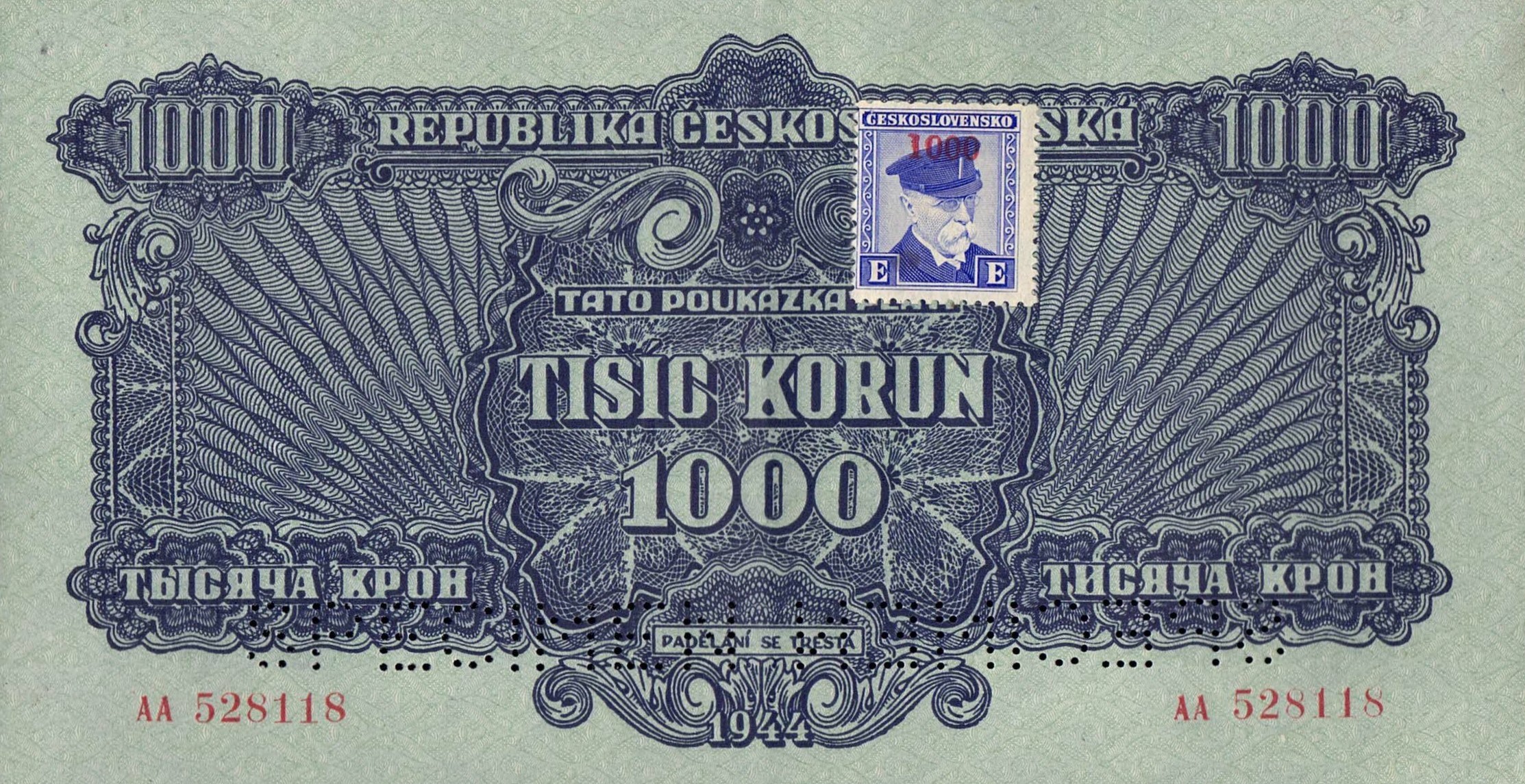
Czechoslovakia 1000 Korun 1945 Specimen – original issue in 1944, printed in Moscow, Russia, stamped in the transition period in 1945, aUNC condition.

Slovakia 500 Korun 1939 Specimen – originally Czechoslovak issue in 1929, printed in New York, USA, stamped shortly after establishment of Slovak state in 1939, VF/F condition.
For collectors, stamped banknotes can be both fascinating and valuable, as they provide insight into historical events and transitions. However, their value depends on several factors:
However, there is no common rule if the baknote is valued more or less when stamped. It all depends on the rarity of the specific banknote.
Stamped banknotes serve as important historical artifacts, reflecting times of change and uncertainty in a country’s financial system. Whether they were issued during the formation of Czechoslovakia, in post-war recovery periods, or during currency splits, these stamps tell stories of transition, adaptation, and national identity. For collectors, they offer a unique connection to history—one that is often more valuable than the banknote itself.


