

Banknotes may not hang in galleries, but they are undoubtedly works of art. Created by talented engravers, illustrators, and designers, each banknote combines artistic skill, cultural symbolism, and technical precision. So how do they compare to traditional art pieces like paintings or sculptures?
First, banknotes are functional art. Unlike paintings, which are made solely for visual enjoyment, banknotes were designed to circulate in everyday life. Yet despite their utility, many feature incredibly detailed portraits, landscapes, and symbolic imagery—often more intricate than what you’ll find in modern graphic design.
Second, banknotes capture history just like classical art. A painting might reflect the spirit of a time, but a banknote reflects the political, cultural, and economic identity of a nation in a very concrete way. The use of national heroes, industrial motifs, or even artistic styles (like Alfons Mucha’s Art Nouveau on early Czechoslovak notes) makes each banknote a small, collectible time capsule.
In the past, not everyone had access to museums or galleries. Art was often limited to the elite or those living in cultural centers. For many, a banknote was the only piece of art they would see regularly. Designers and engravers understood this, and many countries deliberately infused their banknotes with beauty and national pride, turning currency into a portable canvas of culture and education.
This democratization of art meant that everyday people—farmers, workers, merchants—could admire finely crafted portraits, architectural designs, or allegorical scenes simply by reaching into their pockets. It was art brought to the people, blending aesthetic experience with everyday life.
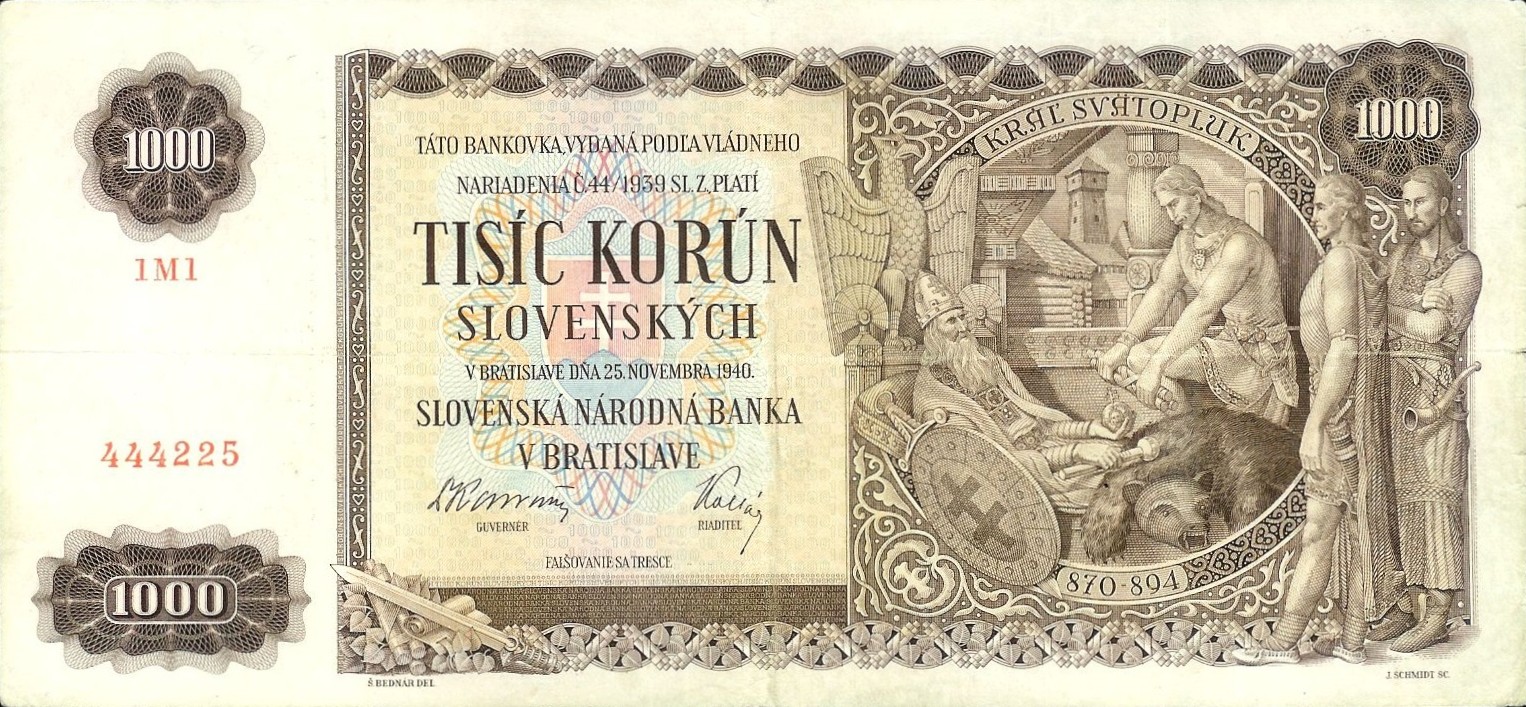
Slovakia 1000 Korun 1940 –banknote depicting King Svatopluk I of Great Moravia, explaining to his sons that if they work together nobody can break them – analogy with three sticks, large note with dimensions of 192x90 mm, VF/F condition.
Banknotes also offer rarity and collectibility, much like fine art. A rare note in uncirculated condition can fetch prices in the thousands, and collectors often seek specific editions, print variations, or specimen notes—just as art collectors chase limited prints or originals.
Finally, the technical side of banknote design is a craft in itself. Security features like watermarks, microprinting, and intaglio engraving turn each note into a blend of art and science, unmatched by most mass-produced modern art.
In short, while they may be printed on paper and used in commerce, banknotes are miniature masterpieces. They are expressions of national identity, historical memory, and creative craftsmanship—designed not just to be spent, but to be seen, studied, and appreciated like any other work of art.


